

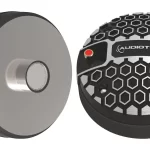
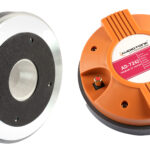
AD-561XLS – High-Power 2″ Compression Driver for Precision HF
The AD-561XLS – High-Power 2″ Compression Driver for Precision HF Performance driver designed for professional sound reinforcement systems, offering exceptional clarity, power, and durability in high-frequency audio reproduction. Built to meet the rigorous demands of PA systems, line arrays, touring setups, and fixed installations, this driver delivers precise and powerful output with outstanding efficiency.
At the core of the AD-561XLS is a 51.3mm (2-inch) copper-clad aluminum (CCAW) voice coil, which provides excellent thermal conductivity and high efficiency. With an RMS power handling capacity of 100W (and program power up to 200W), it can handle continuous high-output operation while maintaining accurate, distortion-free audio.
The 108 ± 2dB sensitivity rating ensures a strong output with minimal power input—ideal for environments where maximum projection and intelligibility are critical.
The unit operates within a frequency range of 800Hz to 16,000Hz, covering a wide band of high-frequency content including vocals, instruments, and effects. Whether used for speech reinforcement or musical applications, the AD-561XLS provides a smooth and detailed response that brings sound to life.
The composite diaphragm is engineered for high stiffness-to-mass ratio and long-term reliability, ensuring consistent performance even under intense operating conditions. The Strontium Ferrite Y35 magnet contributes to strong magnetic flux, enhancing overall efficiency and transient response.
Designed for flexible installation, the AD-561XLS features a 25mm (1-inch) throat diameter and a screw-on mounting design. This makes it compatible with a wide range of horn flares and enclosures. With a 134mm overall diameter and weighing 2.7 kg, it offers solid structural stability while maintaining a manageable size. This makes it a reliable choice for both portable sound systems and fixed installations.
FAQ Section
1. How does air turbulence inside the phase plug paths create high-frequency distortion, and how does this model maintain clean vocal textures?
When a high-power compression driver pushes massive sound waves through a tiny throat, air is subjected to extreme mechanical compression. If the narrow slots inside the phase plug have sharp edges or uneven pathways, the air velocity becomes unstable, creating microscopic air turbulence.
2. What mechanical issues can occur when matching a 1-inch screw-on driver with heavy aluminum horn flares, and how do you protect the threads?
The universal screw-on design provides incredible compatibility, but spinning a driver with a heavy Strontium Ferrite Y35 magnet onto a large, thick aluminum horn flare can put immense stress on the mounting point. If the speaker cabinet experiences heavy physical bouncing during road transit, the weight of the magnet can strip the soft precision threads or cause cross-threading fractures.
3. Why do certain high-frequency drivers lose their top-end response above $15\text{KHz}$ when driven hard, and how does the Y35 motor gap address this?
A common issue in pro audio is the drop-off of extreme upper treble frequencies when the voice coil gets hot. As the coil moves rapidly, it creates its own reverse magnetic fields that fight the main motor magnet. If the magnetic gap is too wide or poorly optimized, these opposing forces cause the voice coil to lose control at fast frequencies, rolling off the crisp air frequencies.
4. How does the high stiffness-to-weight ratio of a pure titanium dome affect transient recovery time during rapid musical attacks?
Electronic dance music, fast percussion, and sharp acoustic snare drum hits require a compression driver diaphragm to start vibrating instantly and, more importantly, stop vibrating immediately after the electrical signal ends. A softer diaphragm material continues to micro-flex or “ring” after a heavy signal strike, blurring the next musical note.
5. When adjusting parametric EQ settings on a system processor, why should you avoid adding a massive boost near the crossover point?
Because this driver has a wide frequency response that drops down to, audio engineers are often tempted to use a digital processor to boost the region to bring out more lower-mid vocal presence. However, this frequency sits right at the mechanical resonance limits of a 1-inch throat structure.
FAQ Section
1. What causes acoustic “comb filtering” when multi-coupling this 2-inch driver inside a line-array grid, and how do you achieve an un-interfered vertical wavefront?
When mounting multiple AD-7207 units into a vertical line-array cluster, the primary physical challenge is preventing the high-frequency waves from overlapping and canceling each other out—a problem known as comb filtering. Because this driver utilizes a large 2-inch (50mm) exit throat, the acoustic wavefront exits as an expanding spherical wave rather than a flat ribbon. If bolted straight onto standard wide-dispersion horns without correction, the acoustic centers sit too far apart, destroying top-end coherency.
2. Why does the selection of a 72.5mm voice coil size change how your system transitions energy compared to smaller 44mm alternatives?
A 72.5mm (3-inch) voice coil architecture completely redefines your system’s mid-high crossover strategy. Smaller 44.4mm drivers have limited moving surface area and low thermal limits, forcing system designers to cross them over high to keep them from burning out. The oversized 3-inch CCAW coil of the AD-7207 creates a massive physical footprint that easily distributes thermal and mechanical loads.
3. What mechanical failures occur when a mobile touring system faces extreme physical vibrations during transport, and how do you test the bolt-on assembly?
With a net weight of 4.65 kg, the bulk of this driver’s mass resides in its heavy Strontium Ferrite Y35 magnet assembly. If a touring rack or speaker stack is transported over rough roads without proper internal dampening, the relentless physical G-forces can stress the rear mounting bolts or slightly shift the top plate relative to the pole piece.
4. How does the high thermal coefficient of the pure titanium dome handle the sudden energy shifts of raw live vocals without micro-fracturing?
Live vocal tracks are highly unpredictable, often presenting explosive dynamic spikes and sharp transients that put intense physical stress on a compression driver’s dome. A low-grade synthetic or thin composite diaphragm can flex or ripple across its surface when hit with sudden high-voltage signals, causing micro-fracturing along the surrounding edge over time. Pure titanium possesses an exceptionally high modulus of elasticity and fatigue resistance.
5. When setting up a multi-way active digital signal processor (DSP), what limiting thresholds safeguard the 72.5mm CCAW coil from long-term over-excursion?
Because the AD-7207 can play down to an aggressive, it is highly vulnerable to mechanical over-excursion if the system processor is improperly tuned. To ensure the 120W RMS power threshold is never breached during a live show, you must set up two distinct layers of protection inside your DSP. First, calculate an RMS limiter calibrated specifically to the continuous voltage capacity of the 8 coil to prevent long-term thermal meltdown.



Reviews
There are no reviews yet.