
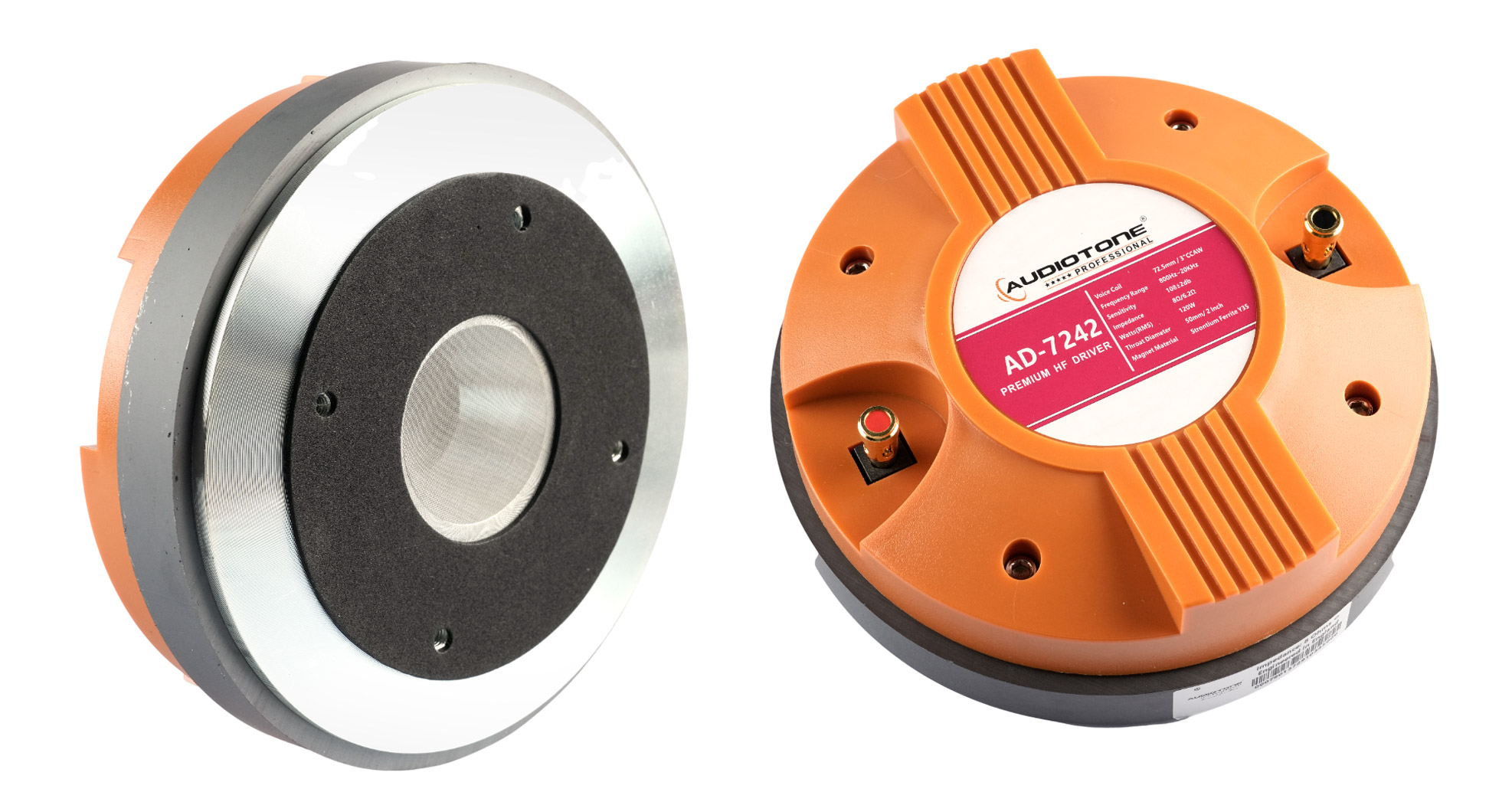
AD-7242 Compression Driver – Precision Meets Power
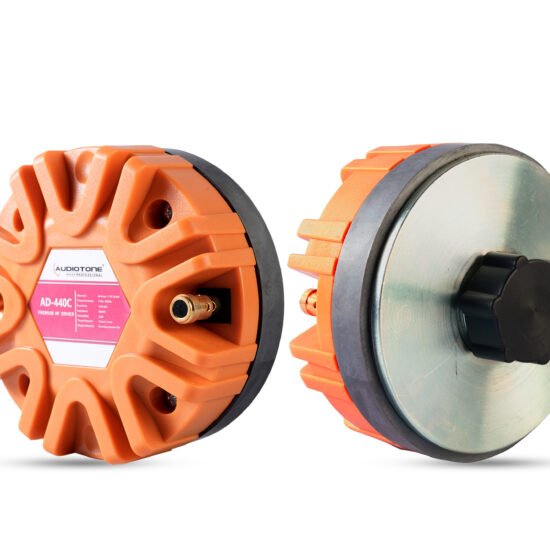
The AD-7242 Compression Driver – Precision Meets Power compression driver, built to deliver exceptional high-frequency performance in professional PA systems, touring rigs, and permanent sound installations. With a powerful 120W RMS power capacity and program power handling up to 240W, it ensures outstanding audio clarity and projection even in the most demanding environments.
At its core lies a 72.5mm (3-inch) CCAW voice coil, engineered for excellent thermal conductivity and high sensitivity. This allows the driver to operate at high power levels without distortion or thermal fatigue. The sensitivity rating of 108 ± 2dB guarantees robust output with minimal power input—ideal for large venues, outdoor events, and high-SPL applications where every decibel counts.
The AD-7242 offers a wide frequency response of 800Hz to 20,000Hz, ensuring accurate reproduction of high frequencies. It delivers exceptional clarity for vocals, instruments, and sound effects. Whether you’re mixing live sound or setting up a fixed system, this driver provides dynamic range and crisp audio performance.
Durability is a key strength of the AD-7242. It features a titanium diaphragm, chosen for its light weight and resistance to fatigue, ensuring long-term reliability under heavy use. The Strontium Ferrite Y35 magnet generates a stable magnetic field for consistent, high-output performance across the entire frequency spectrum.
The AD-7242 measures 170mm in overall diameter and weighs 4.65 kg, providing a solid, durable build. It’s engineered for rugged use while remaining flexible enough for integration into mobile rigs and fixed installations.
Whether you’re upgrading your existing setup or building a new system from the ground up, the AD-7242 compression driver combines power, precision, and durability in a compact, professional-grade format. It’s the ideal solution for audio professionals who demand reliability, sonic excellence, and long-term performance.
FAQ Section
1. How does a 1.4-inch (36mm) exit path prevent high-frequency “beaming” while preserving mid-range vocal depth compared to standard 2-inch drivers?
When designing large venue setups, standard 2-inch exit drivers often struggle with a phenomenon called acoustic beaming, where frequencies above 10KHz narrow into a sharp, laser-like beam that completely misses the side audience. Conversely, small 1-inch drivers cannot drop low enough to cover vital vocal frequencies. The 1.4-inch (36mm) exit throat layout of the AD-7242-2 serves as the ultimate acoustic bridge.
2. What structural damage occurs when a high-power compression driver is exposed to amplifier DC offset, and how do you test for it on a bench?
If a system amplifier suffers an internal component failure or clips severely, it can leak constant DC voltage into the speaker line. Because compression drivers are meant to process alternating current (AC), a DC offset stalls the 72.2mm voice coil, locking it in a fixed forward or backward position within the magnet gap. Lacking moving air to cool it, the CCAW wire rapidly overheats, bubbling the insulation coating and swelling the polyimide former until it physically jams against the metal pole pieces.
3. Why does a pure titanium diaphragm handle continuous high-power outdoor touring loads better than synthetic composite domes?
Outdoor summer music festivals and multi-day concert tours put immense mechanical fatigue on high-frequency transducers due to shifts in humidity and prolonged high-volume playback. Under these brutal conditions, synthetic composite or plastic domes can lose their structural tension, leading to micro-flexing along the surround edges which blurs transient details. Pure titanium possesses an exceptionally high modulus of elasticity and mechanical tensile strength.
4. How does the high coercivity of a Strontium Ferrite Y35 motor protect a driver from permanent demagnetization during extreme voltage spikes?
During large live concert sets, sudden bursts of microphone feedback or heavy electronic synth drops send massive, opposing electrical currents into the speaker cabinet. In low-grade drivers, these reverse electromagnetic fields can physically demagnetize cheap barium magnets, permanently robbing the speaker of its original efficiency and volume. The AD-7242-2 utilizes premium Strontium Ferrite Y35, which features extremely high coercivity.
5. When grouping multiple 110dB efficient drivers in a line-array cluster, how must you manage the processor gain staging to avoid a noisy system hiss?
An ultra-high sensitivity rating means this driver is an exceptionally efficient transducer, converting minimal amplifier voltage into massive sound pressure levels. In a large line array hung next to lower-efficiency subwoofers, leaving your high-frequency amplifier channels wide open will instantly expose the internal noise floor or “hiss” of your mixing console and digital processors.




Reviews
There are no reviews yet.