
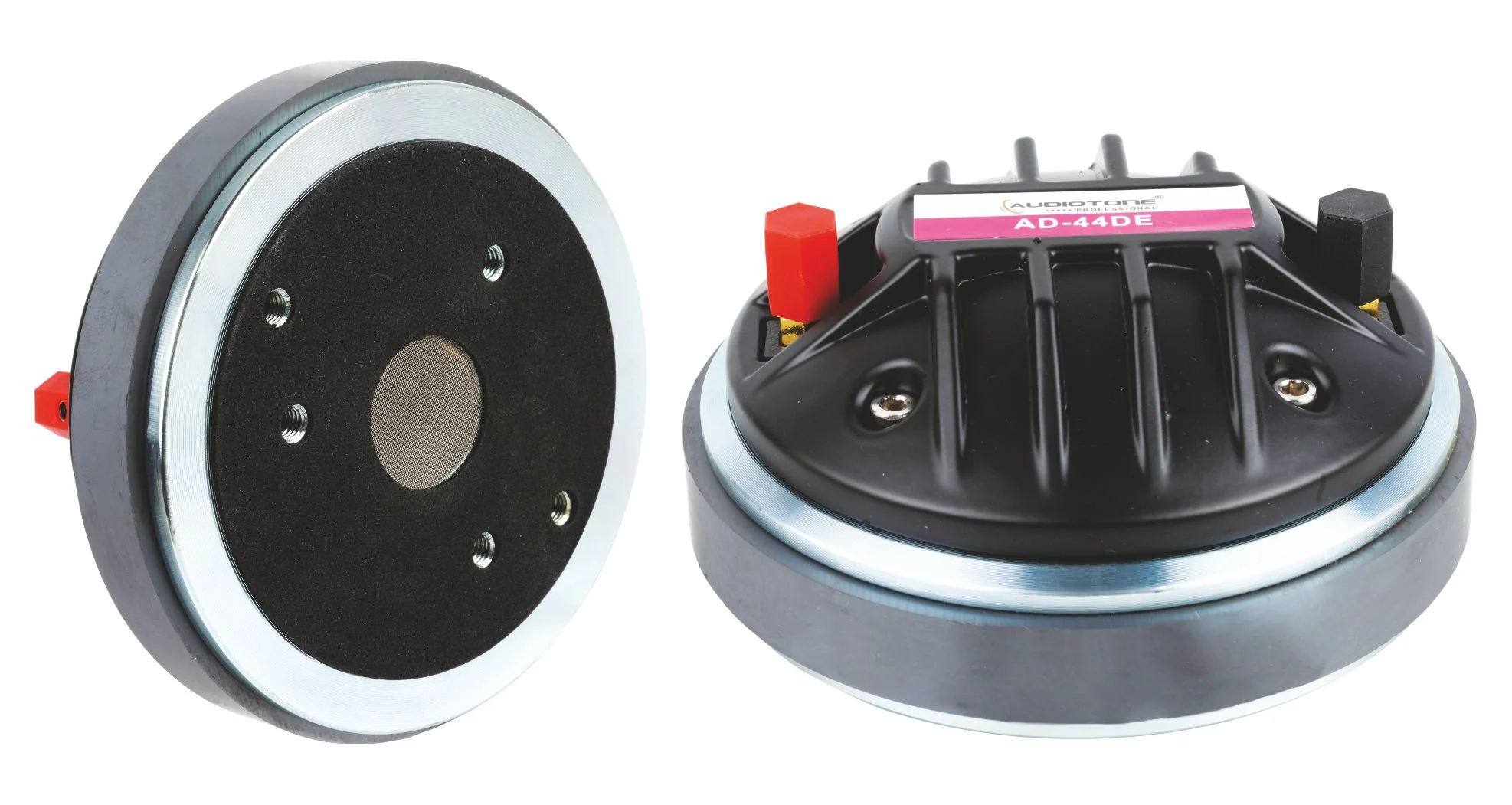
AD-44DE Compression Driver
The AD-44DE Compression Driver 1-inch throat compression driver designed for clear and powerful high-frequency audio. It is perfect for professional PA systems and sound reinforcement setups. Built for both efficiency and durability, the AD-44DE delivers consistent clarity across a wide frequency range. Its compact size also makes it ideal for portable setups without compromising performance.
At the core of the AD-44DE is a 44.4mm (1.75″) CCAW voice coil, offering superior conductivity and thermal stability. With an RMS power capacity of 80W, it delivers ample output while maintaining exceptional audio detail, even during extended use. The driver boasts an impressive sensitivity rating of 106 ± 2dB, ensuring high output levels with minimal power input — making it an excellent choice for stage monitors, portable PA systems, fixed installations, and compact horn arrays.
Covering a frequency response range of 800Hz to 16,000Hz, the AD-44DE ensures crisp and accurate reproduction of mid and high frequencies. This broad range allows it to handle vocals, cymbals, and other treble-rich content with exceptional clarity and presence.
The unit features a 25mm (1 inch) throat diameter and a standard bolt-on mounting design. This makes it compatible with a wide range of horn flares and enclosures. With an overall diameter of 115mm and a lightweight build of just 1.62 kg, it integrates easily into both portable and fixed systems. Despite its compact size, it delivers powerful performance without compromise.
The diaphragm is made from durable PEN (Polyethylene Naphthalate), a material known for its stiffness-to-weight ratio and fatigue resistance. This ensures long-term reliability in high-performance applications. The driver is paired with a Strontium Ferrite Y35 magnet, which delivers stable magnetic flux and excellent dynamic response. This combination makes the AD-44DE ideal for demanding live sound environments.
Available in 8Ω and 6Ω impedance variants, this driver gives system designers the flexibility to match amplifier and speaker configurations with ease.
Whether you’re building a new sound system or upgrading your high-frequency components, the AD-44DE offers the perfect balance of performance, efficiency, and reliability.
FAQ Section
What physical indicator warns that the 1.75-inch CCAW voice coil has experienced severe clipping, and how do you diagnose it before a total burnout?
Before a complete electrical open-circuit failure occurs, a compression driver suffering from severe amplifier clipping will exhibit a distinct distortion artifact known as “throaty rasping” or a sudden drop in output efficiency at specific vocal frequencies. If you open the magnet assembly to inspect the 44.4mm coil, you will see a dark amber or blackened discoloration on the polyimide voice coil former, accompanied by a bubbling of the wire insulation adhesive.
How does a 1-inch (25mm) exit throat limit or optimize your choice of horn flares when building compact stage monitors?
A 1-inch (25mm) exit throat is structurally calculated to maximize high-frequency wave velocity, which is perfect for maintaining tight control over the sound pattern. When building wedge stage monitors, this smaller throat diameter allows you to couple the driver with compact.
Why do mobile DJ setups running outdoor summer soundchecks notice the treble becoming dull after an hour, and what is the physics behind it?
This loss of crispness is caused by thermal power compression inside the magnetic motor structure. As the AD-44DE handles continuous 50W to 60W RMS loads in high ambient heat, the temperature inside the voice coil gap rises steadily. Because copper and aluminum increase their electrical resistance as they heat up, the driver draws less current from the amplifier at the same volume setting.
What mechanical advantages does a titanium-polymer hybrid dome offer over a pure titanium diaphragm in 44.4mm drivers?
While pure titanium domes are incredibly rigid and project sound over long distances, they have a natural tendency to produce sharp resonance peaks and harsh modal ringing at the upper end of the frequency spectrum ($15\text{KHz} \sim 20\text{KHz}$). A hybrid titanium-polymer design resolves this by using a rigid titanium dome for punchy vocal projection, paired with a flexible polymer surround.
When configuring a compact 2-way cabinet, how does a 106dB sensitivity rating alter your passive crossover pad design?
An efficiency rating of this high-frequency driver is far more efficient than the 12-inch or 15-inch mid-bass woofers it is typically paired with, which usually sit around 96dB to 98dB sensitivity. If you connect them to a passive crossover network without adjustments, the treble will completely overpower the bass, creating an incredibly bright and unbalanced sound.



Reviews
There are no reviews yet.